Accounts Receivable Management: How to Get Paid Faster
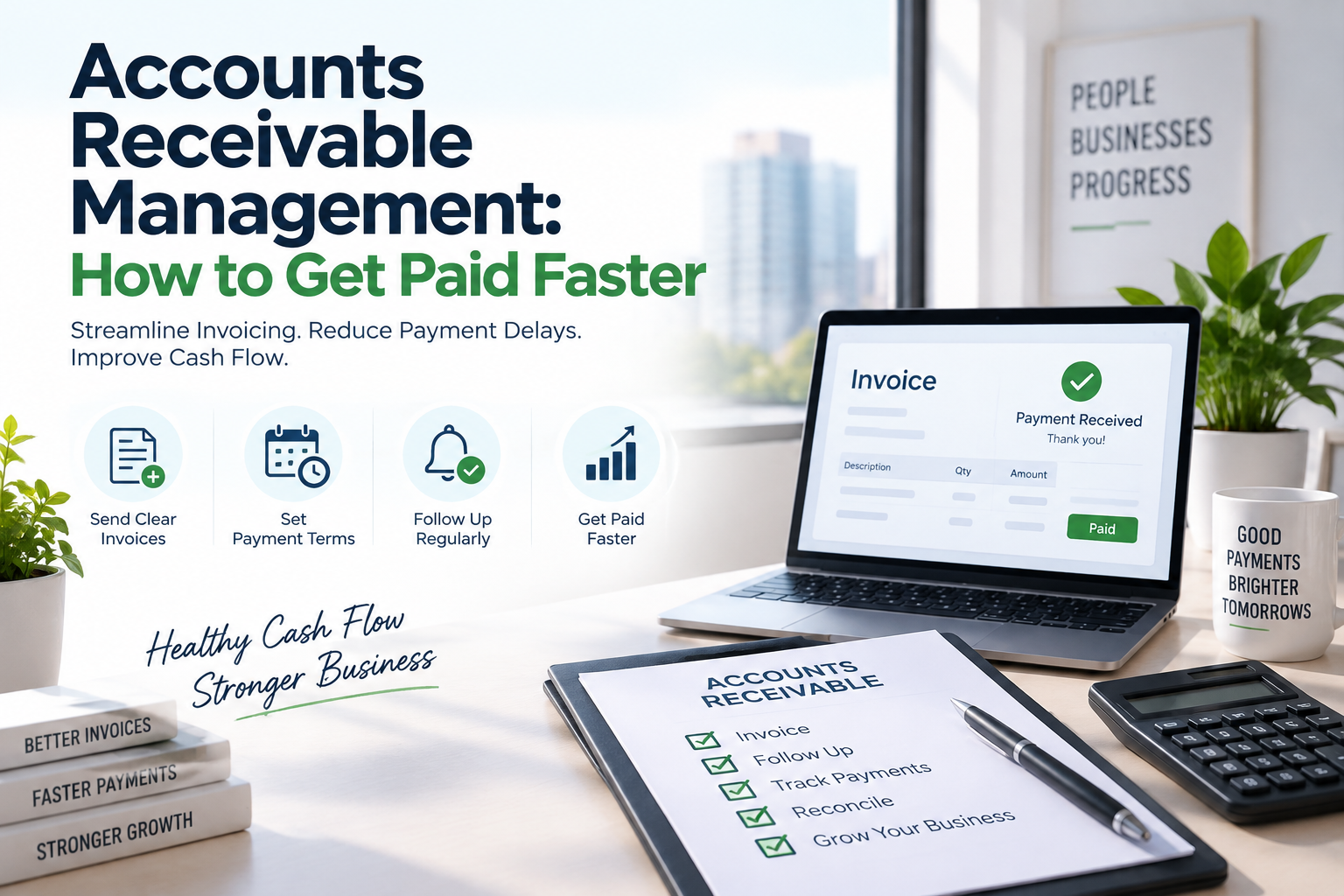
Getting paid on time is essential for every business. You may have a strong sales pipeline, loyal customers, and a growing client base, but delayed payments can still create serious cash flow problems. This is where effective accounts receivable management plays an important role.
Accounts receivable refers to the money customers owe your business for products or services already delivered. When customers take too long to pay, your business may struggle to cover expenses, pay suppliers, manage salaries, or invest in growth.
The good news is that businesses can improve the way they manage receivables and create a faster, more organized payment collection process.
In this guide, we will explain what accounts receivable management is, why customers delay payments, and practical strategies to help your business get paid faster.
What Is Accounts Receivable Management?
Accounts receivable management is the process of tracking, managing, and collecting money owed to a business by its customers.
For example, if your business provides a service worth ₹50,000 and gives the customer 30 days to make the payment, the ₹50,000 is recorded as an account receivable until the customer pays.
The process usually involves:
- Creating and sending invoices
- Setting payment terms
- Tracking outstanding payments
- Monitoring due dates
- Sending payment reminders
- Following up on overdue invoices
- Recording customer payments
- Reviewing unpaid balances
The main objective of accounts receivable management is simple: collect the money your business has earned as quickly and efficiently as possible.
Why Getting Paid Faster Matters
Fast payments help businesses maintain healthy cash flow.
When customers pay on time, your business can use the money to manage:
- Employee salaries
- Supplier payments
- Operating expenses
- Inventory purchases
- Rent and utilities
- Business expansion
However, slow payments can create a gap between making a sale and having cash available in the bank.
For example, a business may have ₹10 lakh in outstanding invoices. On paper, the company appears to have earned that revenue. But if customers delay payment, the business may still face difficulty paying its own expenses.
Effective accounts receivable management helps close this gap.
Why Do Customers Pay Late?
Understanding why customers delay payments can help you improve your collection process.
1. The Invoice Was Sent Late
If you delay sending an invoice, you also delay the customer's payment process.
Invoices should be generated and sent immediately after a product is delivered or a service is completed.
2. Payment Terms Were Not Clear
Customers may delay payment when they are unsure about the due date or payment method.
Always communicate payment terms clearly before and during the transaction.
3. The Invoice Contains Errors
Incorrect invoice details can delay payment approval.
Common errors include:
- Incorrect customer information
- Wrong amounts
- Missing purchase order numbers
- Incorrect tax details
- Missing payment instructions
4. The Customer Forgot
Busy customers may simply overlook an invoice or due date.
This is why payment reminders are an important part of receivables management.
5. The Payment Process Is Complicated
Customers may delay payment if the process is difficult or unclear.
A simple payment experience can reduce unnecessary friction.
10 Ways to Get Paid Faster Through Better Accounts Receivable Management
1. Send Invoices Immediately
One of the easiest ways to improve payment speed is to invoice customers quickly.
Do not wait until the end of the week or month if the product or service has already been delivered.
The faster the invoice is sent, the sooner the payment process can begin.
Using accounting software can help businesses create invoices more efficiently and maintain better records.
2. Set Clear Payment Terms
Every invoice should clearly show:
- Invoice date
- Payment due date
- Total amount payable
- Payment terms
- Payment instructions
Instead of using vague terms, clearly communicate the exact payment deadline.
For example:
Payment due: 15 September 2026
This can be clearer than simply stating a payment term that the customer may misunderstand.
3. Make Your Invoices Accurate
Invoice errors are a common reason for delayed payments.
Before sending an invoice, check:
- Customer name
- Billing address
- Contact information
- Invoice amount
- Tax details
- Product or service information
- Purchase order details
- Payment instructions
An accurate invoice reduces back-and-forth communication and makes it easier for the customer to approve payment.
4. Offer Convenient Payment Options
Making payments easier can help customers pay faster.
Depending on your business and customer preferences, consider offering suitable digital payment methods.
The goal is to reduce unnecessary steps between receiving the invoice and completing the payment.
5. Send Payment Reminders
Customers should not receive their first communication only after the invoice becomes overdue.
A structured reminder process may include:
- A reminder before the due date
- A notification on the due date
- A follow-up after the due date
For example:
Before due date: “A friendly reminder that Invoice #123 is due on 15 September.”
After due date: “Our records show that Invoice #123 is currently overdue. Please review and arrange payment at your earliest convenience.”
Automated reminders can make this process more consistent.
6. Follow Up Quickly on Overdue Invoices
The longer you wait to follow up, the greater the chance that an invoice will remain unpaid.
Create a clear collection schedule.
For example:
- 3 days overdue: Friendly reminder
- 7 days overdue: Follow-up email
- 14 days overdue: Phone call or direct communication
- 30 days overdue: Formal collection action according to your company policy
The exact process will depend on your business, customer relationship, and payment terms.
7. Use Accounts Receivable Aging Reports
An accounts receivable aging report shows how long invoices have remained unpaid.
Receivables are often categorized as:
- Current
- 1–30 days overdue
- 31–60 days overdue
- 61–90 days overdue
- More than 90 days overdue
This helps businesses prioritize collection efforts.
For example, a customer who is 90 days overdue may require more immediate attention than one who is only three days late.
8. Monitor Customer Payment Behaviour
Not all customers have the same payment habits.
Some customers consistently pay before the due date, while others may repeatedly delay payments.
Reviewing payment history can help you identify:
- Customers who frequently pay late
- Customers with large outstanding balances
- Customers who regularly dispute invoices
- High-risk accounts
This information can help you decide whether to change credit terms or require advance payments for future transactions.
9. Automate Your Receivables Process
Manual receivables management can be time-consuming.
When teams rely on spreadsheets, emails, and manual reminders, it becomes easier to:
- Forget follow-ups
- Miss payment deadlines
- Enter incorrect data
- Lose track of customer balances
Automation can help businesses streamline repetitive tasks such as invoice creation, payment reminders, due-date monitoring, and financial reporting.
A centralized accounting solution can also provide better visibility into outstanding receivables.
10. Track Your Collection Performance
Businesses should regularly measure how effectively they collect payments.
One important metric is Days Sales Outstanding (DSO).
DSO measures the average number of days it takes a business to collect payment after making a sale.
A high DSO may indicate slow collection, while a lower DSO can indicate that the business is collecting payments more quickly.
Other useful metrics include:
- Accounts receivable turnover
- Percentage of overdue invoices
- Average payment delay
- Total outstanding receivables
- Bad debt percentage
Monitoring these numbers can help you identify opportunities to improve your accounts receivable management strategy.
Best Practices for Accounts Receivable Management
A successful receivables process should be proactive rather than reactive.
Create a Clear Credit Policy
Before offering credit, businesses should define their payment rules.
A credit policy can include:
- Credit limits
- Payment terms
- Approval requirements
- Late-payment procedures
- Collection procedures
Having a consistent policy helps employees and customers understand what is expected.
Build a Regular Collection Routine
Do not wait until cash flow becomes a problem to review outstanding payments.
Set aside regular time to review:
- Invoices due soon
- Recently overdue payments
- High-value outstanding invoices
- Long-term overdue accounts
Maintain Professional Communication
Payment follow-ups should be polite, clear, and consistent.
Include:
- Customer name
- Invoice number
- Outstanding amount
- Due date
- Payment instructions
Good communication can help resolve payment issues without damaging customer relationships.
Review Your Process Regularly
Customer behaviour and business requirements can change.
Regularly review whether:
- Your payment terms are working
- Invoices are being sent on time
- Customers understand the payment process
- Follow-ups are happening consistently
- Overdue payments are increasing or decreasing
Continuous improvement can help you build a stronger collection process.
How Technology Can Help Businesses Get Paid Faster
Modern accounting technology can reduce the administrative burden of managing receivables.
Instead of switching between different spreadsheets and systems, businesses can manage financial information through a centralized platform.
Digital accounting solutions can support:
- Invoice management
- Outstanding balance tracking
- Payment monitoring
- Automated workflows
- Financial reporting
- Better visibility into receivables
Automation does not completely replace human communication. However, it can reduce repetitive administrative work and help ensure that important payment activities are not missed.
How Comptes Can Support Your Financial Management
Managing business finances through spreadsheets and disconnected tools can make it difficult to maintain accurate information.
A centralized accounting platform can help businesses organize financial operations and improve visibility.
Comptes provides cloud-based accounting and business financial management capabilities that can support invoicing, expense management, reporting, and financial operations.
With better visibility into invoices and financial information, businesses can build more organized processes for managing accounts receivable and monitoring outstanding payments.
Simplify Your Accounts Receivable Process with Comptes
Getting paid faster starts with having better visibility and control over your financial operations.
Comptes helps businesses manage accounting, invoicing, expenses, and financial information through a centralized cloud-based platform.
If your business wants to reduce manual financial processes and create a more organized approach to managing receivables, explore how Comptes can support your financial operations.
Visit Comptes today to simplify your business accounting and financial management.
Conclusion
Effective accounts receivable management is essential for businesses that want to improve cash flow and get paid faster.
The process begins with clear payment policies and accurate invoices. It continues through regular payment tracking, reminders, professional follow-ups, and continuous performance monitoring.
Businesses should not wait until an invoice is severely overdue before taking action. By creating a proactive receivables process, making payments easier, and using technology to reduce manual work, companies can improve their chances of receiving payments on time.
Getting paid faster does not always require aggressive collection practices. In many cases, it requires a simpler and more consistent process.
With the right strategy, clear communication, and appropriate financial tools, businesses can reduce payment delays and maintain stronger cash flow.
Frequently Asked Questions
1. What is accounts receivable management?
Accounts receivable management is the process of tracking and collecting money that customers owe to a business for products or services already delivered.
2. How can I get customers to pay invoices faster?
You can improve payment speed by sending invoices immediately, setting clear due dates, avoiding invoice errors, offering convenient payment methods, and sending timely reminders.
3. Why are accounts receivable important for cash flow?
Accounts receivable represent money that your business has earned but has not yet received. Collecting these payments quickly helps improve working capital and cash flow.
4. What is an accounts receivable ageing report?
An accounts receivable aging report organizes unpaid invoices according to how long they have been outstanding. It helps businesses identify which payments require immediate attention.
5. How often should businesses follow up on overdue invoices?
Businesses should follow up according to a consistent collection schedule. A reminder before the due date and prompt follow-ups after the due date can help reduce payment delays.
6. What is Days Sales Outstanding (DSO)?
Days Sales Outstanding is a financial metric that estimates the average number of days it takes a business to collect payment after a sale. A lower DSO generally indicates faster collection.
7. Can accounting software help businesses manage accounts receivable?
Yes. Accounting software can help businesses manage invoices, track outstanding balances, monitor due dates, automate routine tasks, and generate financial reports.
8. How can Comptes help businesses manage their finances?
Comptes provides a cloud-based platform designed to help businesses manage accounting, invoicing, expenses, reporting, and other financial operations from a centralized system.
Other Blog
 +91-889 103 3012
 +91-889 103 3012
 Email
 Facebook
 Instagram
 Linkedin
 Youtube
 X


© Copyright 2024 Lutsel Technologies Pvt Ltd. All Rights Reserved